Simplii x Redesign Onboarding

UX Research for Redesigning Onboarding Experience to Improve Cross-Sell Adoption

Opening a bank account should feel simple—but for many new customers at Simplii, the process was confusing.
In Fall 2024, conversion rates showed a gap: while most people completed the No Fee Chequing Account (62%), far fewer opted into Overdraft (48%) or the Chequing + Saving Accounts bundle (61%).

Our challenge? Redesign the onboarding and cross-sell experience so that customers not only sign up, but also confidently understand and adopt additional products.

Through user research, we uncovered insights that guided a redesign—simplifying the journey, clarifying next steps, and encouraging greater product adoption.”

ROLE

User Experience Researcher

TIMELINE

4 Weeks | Feb 2025

Industry

Digital Banking

METHODOLOGY

Moderated Usability Testing
STUDY OVERVIEW.

In Feb 2025, we conducted a moderated usability study with 8 Canadian participants (aged 25–35) to evaluate Simplii Financial’s updated onboarding and cross-sell experience.

  • Focus areas:

    • No Fee Chequing Account (NFCA) with overdraft

    • NFCA bundled with High Interest Savings Account (HISA)

  • Tools: Figma (prototype), Maze (testing), System Usability Scale (SUS)


RESEARCH OBJECTIVES.


  1. Identify usability gaps, terminology confusion, and drop-off triggers in the onboarding journey.

  2. Assess engagement with the new cross-sell flow.


IMPACTS.

Improved clarity: Findings highlighted major confusion around terminology (e.g., overdraft fees, offer conditions, SIN requirement).


Redesigned flows: Recommendations directly shaped design updates, including button labels, confirmation screen language, and content placement.


Validated usability: SUS scores showed excellent usability for overdraft flow (95/100) and very good usability for HISA bundle (89/100)


PROCESS.
  • Project Alignment: Defined scope and clarified UX mertics

  • Study planing.—-Moderated Usability Tests: 8 participants explored NFCA + Overdraft and NFCA + HISA journeys.

  • Study Analysis.—-System Usability Scale (SUS): Measured perceived usability.

  • Results —-Findings & Recommendations: Categorized by severity (High, Medium, Low) to prioritize redesign.

  • Iteration: Delivered actionable insights to design and product teams.

Study planing.

Study Analysis.


Translating Research Insight into Design Decisions


Understanding the business problems

As a first step, it was critical to gather internal and external data that would help frame the problem, contextualize the landscape, and garner a thorough understanding of stakeholders and factors influencing the challenge ahead.


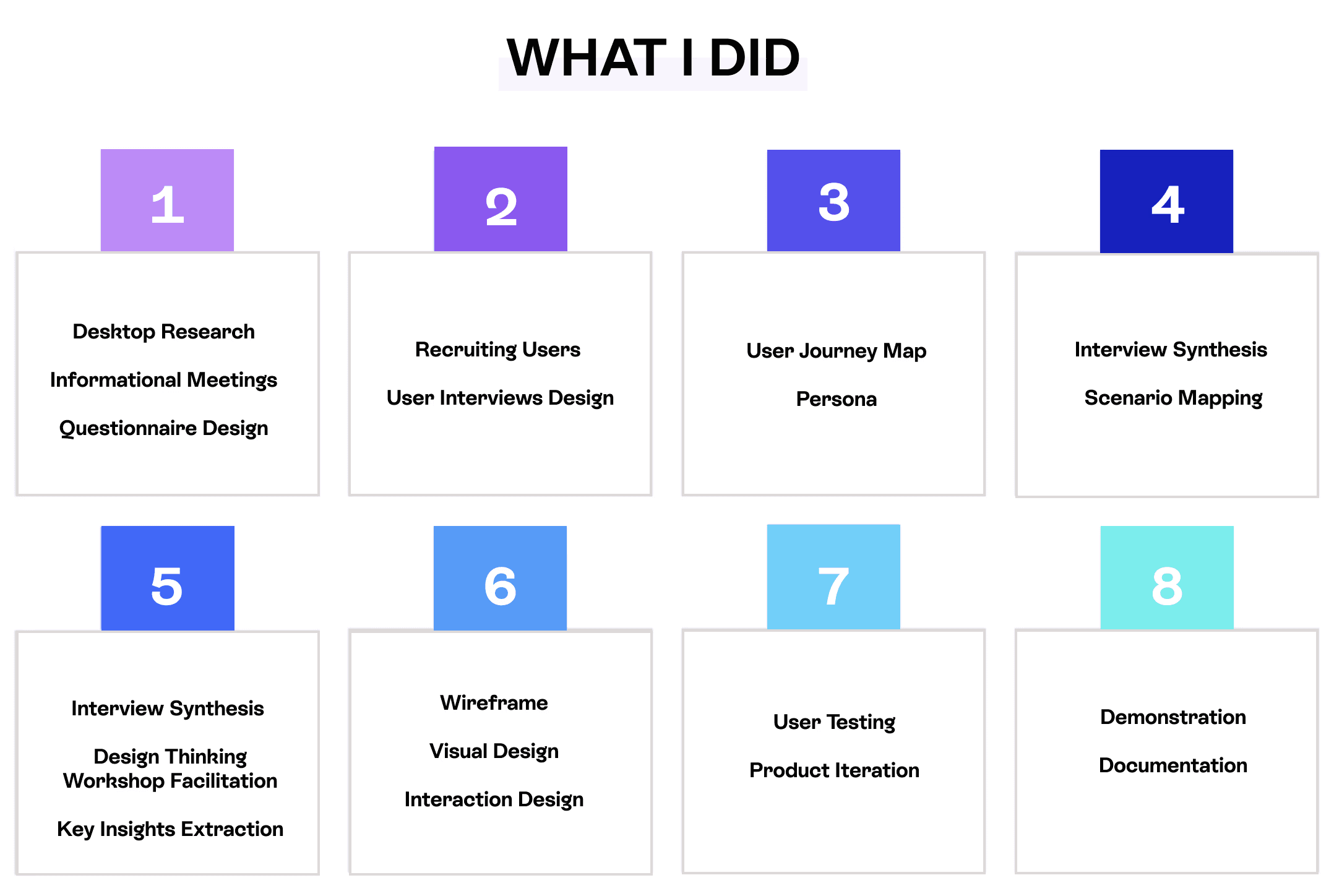
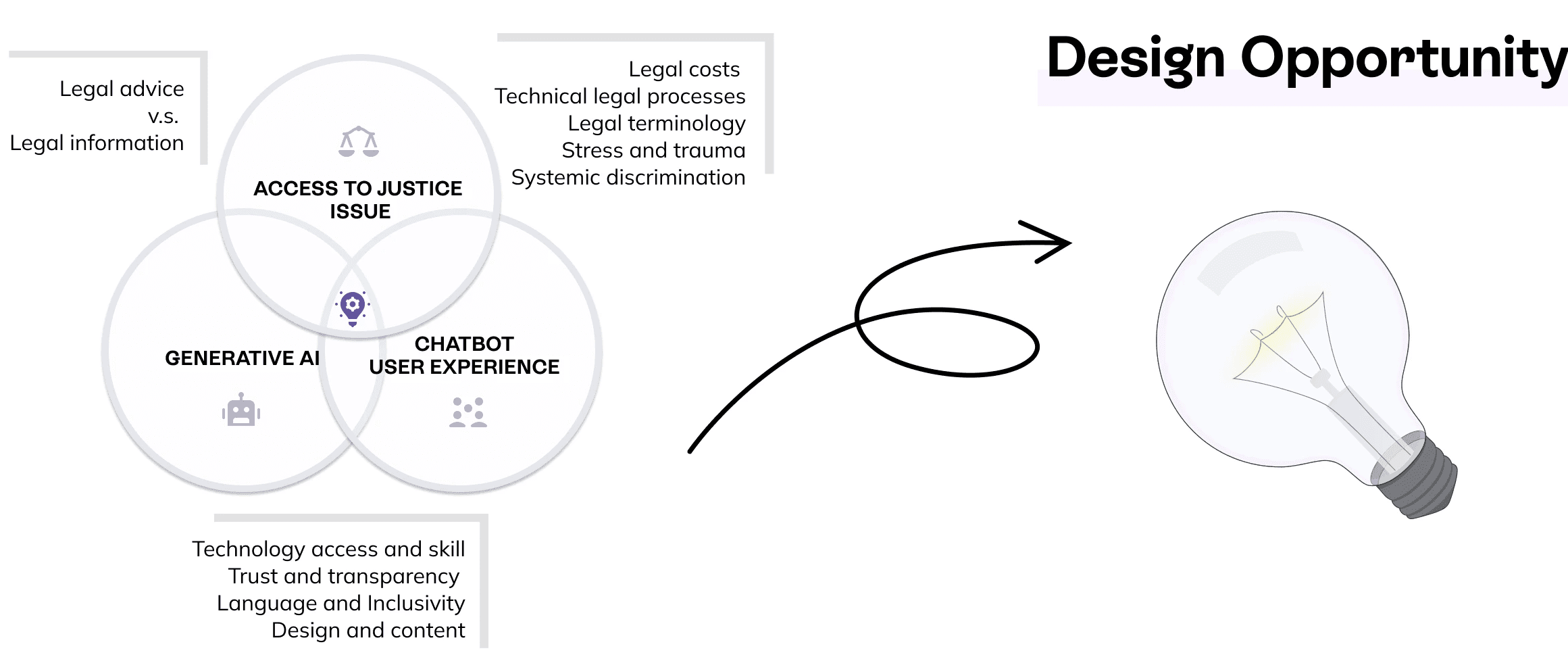
  1. Desktop Research - ‘Access to Justice’ Landscape & technology audit

Reviewing existing research and collecting useful documentation that help the team to better understand the ‘access to justice’ issue.


  1. Competitive Analysis

Analyzing comparative experiences provided us with an understanding of what was potentially viable and fostered our ability to


Defining the Project Strategy


  1. User Interviews

Conducted semi-structured interviews with a diverse group of participants, including those who have faced legal issues, to dive deeper into their experiences, needs, and concerns.


  1. User Personas

Created user personas based on users’ background information, behaviour needs and legal problem types; and bucketing them into categories, which helped the team to develop personalized user journeys that satisfy different types of users.


  1. Facilitating Workshops

Balance between users needs and wants with how do we monetize this so we can continue reinvesting the capital to make this product even better. 


RESULTS.


Translating Research Insight into Design Decisions


Understanding the business problems

As a first step, it was critical to gather internal and external data that would help frame the problem, contextualize the landscape, and garner a thorough understanding of stakeholders and factors influencing the challenge ahead.


MY LEARNINGS.

MY LEARNINGS.

Starting strategic projects with a pragmatic approach.

  • Don’t start fire! You need a strategy to deliver “bad news” - and it takes practice.

  • Individual 1:1s with Leads before the team-wide research readouts help getting buy-in.

  • The more you engage stakeholders in every stage of the research process, the more they are willing to act upon your findings.


More projects to explore.

Let’s work together.

Available For Work


chelsea.chao.zhang@outlook.com

chelsea.chao.zhang@outlook.com

All rights reserved,

Chelsea ©2025

Let’s work together.

Available For Work


chelsea.chao.zhang@outlook.com

chelsea.chao.zhang@outlook.com

All rights reserved, Chelsea ©2025

Let’s work together.

Available For Work


chelsea.chao.zhang@outlook.com

chelsea.chao.zhang@outlook.com

All rights reserved,

Chelsea ©2025